
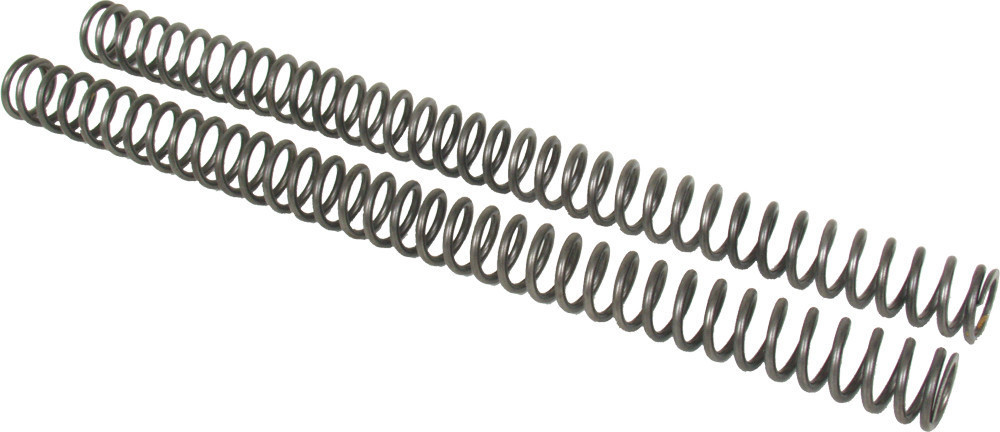
Fork Springs
About Fork Springs
Fork springs hold up the front of the motorcycle, and their stiffness, called spring rate, decides how far the front end drops under braking and how it carries your weight. Riders shop here when the front feels soft or harsh for their weight, after adding luggage or a passenger, or to lower the front end.
Spring rate is listed in N/mm or kg/mm, and 1 kg/mm is about 9.8 N/mm. Pick the rate from the maker's chart for your weight with gear and the way you ride, since a heavier rider needs a stiffer spring. Straight-rate springs have one rate throughout, while progressive springs get stiffer as they compress. The spring must also match your fork's diameter and length, so many listings show a size such as 43.5 mm and a list of models, and some lowering springs are listed for particular bikes. Always replace the springs in both legs together. Springs fix a rate mismatch, but they will not cure leaking seals or worn damping.
Brands listed here include FACTORY CONNECTION, RACE TECH, BBR MOTORSPORTS, LEGEND SUSPENSION and PROGRESSIVE SUSPENSION. Pick your bike in the Ride Finder at the top of the page. When you open the forks, you may also want Fork Seals & Gaskets or Fork Rebuild Kits. The group is Fork Suspension & Parts.
FAQs on motorcycle fork springs
What does fork spring rate mean?
Spring rate is how much force it takes to compress the spring a given distance, listed in N/mm or kg/mm. A higher number means a stiffer spring. To compare, 1 kg/mm is about 9.8 N/mm.
How do I choose the right fork spring rate?
Use the spring maker's chart for your model, matching your weight with riding gear and your type of riding. A heavier rider or a loaded bike needs a stiffer rate, and the best choice leaves the bike with sensible sag.
Do both fork springs need to be replaced together?
Yes. The springs in the two legs should be identical, so the front end compresses evenly. Replace both at once, and use the same oil level and amount in each leg.
What is the difference between a progressive and a straight-rate spring?
A straight-rate spring has a constant rate throughout its travel. A progressive spring becomes stiffer as it compresses, which can add support late in the stroke. Which is better depends on the fork and the riding you do.
Will new fork springs fix a harsh or soft front end?
They help if the rate does not suit your weight. They do not cure worn damping, low or old oil, or leaking seals, so check those at the same time. Oil level and viscosity also change how the front end behaves.