
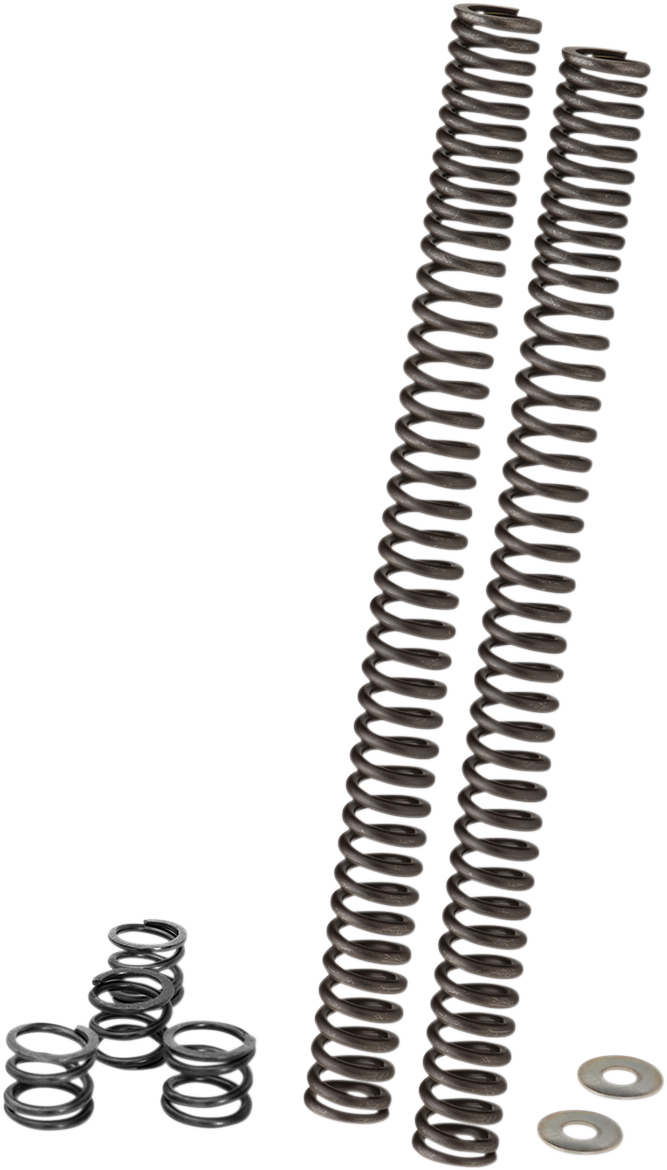
Suspension Springs
About Suspension Springs
A suspension spring holds up the weight of the bike and rider and decides how far the suspension sinks under load. Riders replace the rear shock spring or the springs inside the fork legs when the stock rate does not suit their weight, their luggage or the way they ride, and when an old spring has sagged.
The number to match is spring rate, which is how much force it takes to compress the spring. Listings state it in N/mm or pounds per inch for rear shock springs and in kg/mm for fork springs. A heavier rider, a passenger or a loaded bike needs a higher rate, and a lighter rider a lower one. A rate that is too soft lets the suspension bottom out, and one that is too stiff rides harshly and never uses its travel.
A rear spring also has to fit the shock body, so check the outside diameter and length in the listing, such as 59 mm or 63 mm, against your shock. Fork springs work as a pair, one in each leg, so change both.
Brands in this category include Factory Connection, SDI, KYB, Race Tech and Ohlins. Pick your motorcycle in the Ride Finder at the top of the page to see springs made for it. Listings cover shock springs, fork springs and a fork spring service kit. A new spring is one part of the setup, so see Shocks & Coil Overs and Fork Suspension & Parts for the rest, Suspension Bearings, Bushings & Seals for wear parts that go with a rebuild, and Suspension & Handling for the whole group.
FAQs on motorcycle suspension springs
What does spring rate mean on a motorcycle shock?
Spring rate is the stiffness of the spring: the force needed to compress it a set distance, shown as N/mm, kg/mm or pounds per inch. A higher number means a stiffer spring. The right rate depends on rider weight with gear, load and riding style, so start from the maker's recommendation for your model.
Are my fork springs too soft for my weight?
Signs include the front end diving deeply under braking, bottoming out over bumps, and the bike sitting low in its travel with you aboard. Measuring sag in full riding gear shows how far the suspension sits compressed, and the owner's manual or the spring maker gives the target range.
Can I put a stiffer spring on my stock rear shock?
Often, if the new spring has the right inside diameter, outside diameter and length for that shock. Many replacement springs are made for specific shock bodies, so check the listing against your shock. A big change in rate can also affect how well the shock's damping suits the bike.
Do I need to change fork oil when I change fork springs?
The fork has to be opened to change the springs, so it is a good time to renew the oil and check the seals and bushings. Oil level and any spacer length come from the service manual or the spring maker's instructions, so follow those for your model.
What do I need to adjust after fitting a new spring?
Reset the sag and preload for your weight in riding gear, because a new spring changes where the suspension sits. Follow the procedure in your manual, then ride the bike and make small changes rather than large ones.