
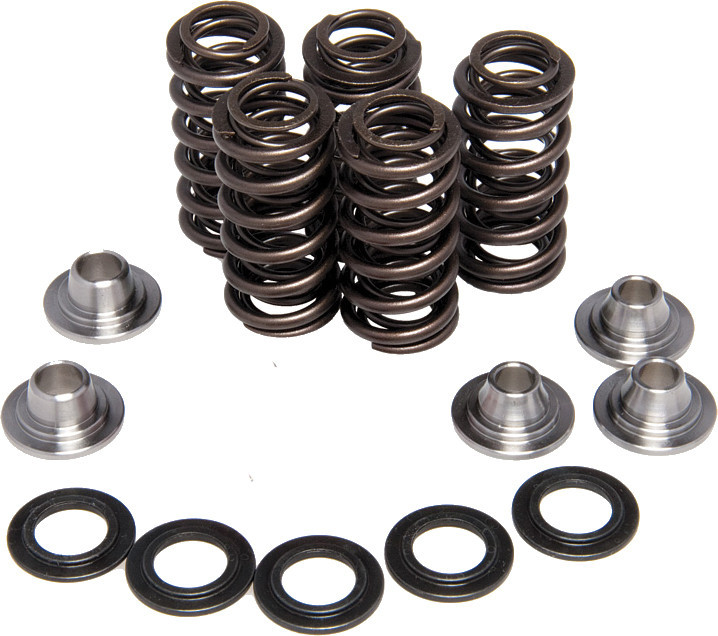
Valve Guides, Springs & Parts
About Valve Guides, Springs & Parts
A valve guide is a sleeve in the cylinder head that holds each valve centered as it slides up and down. A valve spring closes the valve and holds it against its seat. When a guide wears, the valve wobbles, oil creeps down the stem and the engine smokes. When a spring weakens, the valve closes late or bounces off its seat at high engine speed. Both are common on a high-hour engine or a top-end rebuild.
Guides here are mostly bronze, listed as intake, exhaust or intake/exhaust, and sold by machine and year range. The valve must fit its guide with the right running clearance, and fitting a guide is a machine shop job because the head is heated and the guide pressed in and finished to size. Racing valve spring kits are stiffer than stock and are meant for use with performance cams or high-revving engines. A stiffer spring adds load to the cam and the rest of the valvetrain, so use them only if your cam setup calls for them.
Brands in this category are Kibblewhite and KPMI. Pick your machine in the Ride Finder at the top of the page to see the parts for it. A guide job calls for Engine Valves and often Camshafts and Rocker Arms & Parts too. The whole group is Valvetrain Component.
FAQs on valve guides and valve springs
What are the signs of worn valve guides?
Blue smoke at startup or on deceleration, oil use and a rough idle are the usual signs, because oil gets past the guide into the cylinder. A machine shop can measure the clearance between each valve stem and its guide to confirm.
Can I replace valve guides at home?
Rarely. The guide has to be pressed or driven out and a new one fitted, and then reamed to the right size and the valve seat cut to match. These steps need special tools, so most riders have a machine shop do the head work.
What does intake/exhaust mean on a valve guide?
It means the same guide part suits both the intake and the exhaust valve on that engine. Other listings name only intake or only exhaust, so the guides are not always shared. Read the listing and check it against your engine.
Do I need racing valve springs?
Only if your build calls for them. Racing springs are stiffer and suit performance cams and high engine speeds. On a stock or work machine, stock-strength springs are enough, and stiffer ones add wear to the cam and the rest of the valvetrain.
How do I know when valve springs are weak?
A spring that has lost length or force can let a valve close late or bounce, which shows as power loss and misfire at higher engine speeds. A shop can measure free length and spring pressure against the specification in your manual.