
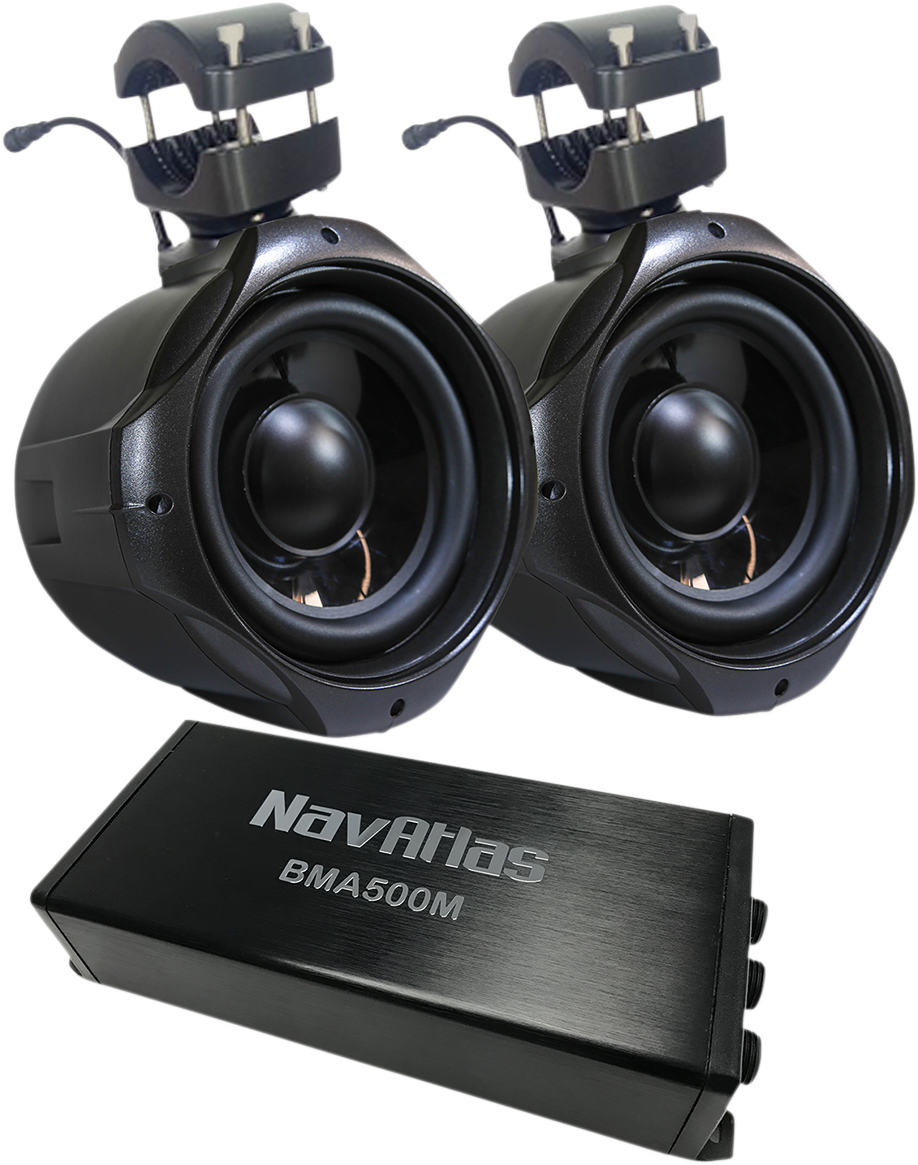
Amplifiers
About Amplifiers
An amplifier supplies the power that moves a speaker cone, and on an open UTV or ATV it is what lets music stay clear over engine and wind noise. Riders add one to get more volume from speakers, to run a subwoofer, or to replace a unit that failed from moisture or vibration.
Three things decide the choice. First, channels. Every speaker or speaker pair and each subwoofer needs a channel, so count what you plan to run now and whether you will add more later. Second, power. Match the amplifier's continuous (RMS) output to the speakers' rating at the same impedance, such as 4 ohms, and treat peak watts as a secondary number. Third, durability, since a unit mounted on an exposed machine should be rated for water and dust. Wiring matters as much as the amplifier. Power and ground wire sized for the amplifier, a fuse near the battery and a clean ground are all needed, and amplifier wiring kits are listed here.
Brands here include Kicker, Boss Audio, Metrix and Navatlas. Related groups are Speakers, Complete Audio Kits and Infotainment & Multimedia Players. For other wiring, see Wiring Harnesses, Cables & Connectors. The whole group is Audio, Communication & Navigation.
FAQs on UTV and ATV amplifiers
How many amplifier channels do I need?
Count one channel for each speaker, or one for each pair if you run them as pairs, plus the subwoofer. A four-channel amplifier can run four speakers, and a five-channel unit adds a subwoofer. Leave room if you plan to add speakers later.
What does RMS power mean when choosing an amplifier?
RMS is the continuous power an amplifier delivers or a speaker can handle, as opposed to the brief peak figure. Match the amplifier's RMS output to the speaker's RMS rating at the same ohm load, so the speaker is not underpowered or overdriven.
Can I power speakers straight from a receiver?
Often yes, since many receivers have a small built-in amplifier. An external amplifier gives more volume with less distortion over wind and engine noise, which matters on an open machine. Check the receiver's and speakers' ratings in the listings.
How do I wire an amplifier safely?
Disconnect the battery first, use the power wire size the amplifier maker lists, fit a fuse near the battery, and ground to clean bare metal on the frame. Keep wires away from heat and moving parts, and follow the wiring kit instructions.